
SAFEST - Toward PFAS-Free Technical Textiles
Developing sustainable surface treatments to replace PFAS in technical textiles.
The textile industry faces the PFAS challenge
Under the European Green Deal, the European Union is pushing its industry toward more responsible production models. The textile sector is particularly affected: it must meet increasingly strict regulatory requirements on the use of chemical substances and on the environmental footprint of its products.
Among these substances, PFAS stand apart. This vast family of synthetic compounds is widely used in technical textiles because it repels water and grease while withstanding chemical and thermal stress.
However, PFAS are now at the center of environmental and health concerns. Nicknamed "forever chemicals" because they persist in the environment for an extremely long time, they are subject to growing regulatory scrutiny in Europe. Their presence also hinders the development of truly circular textile value chain.
The challenge, then, is to find PFAS-free alternatives that deliver the same performance, since technical textile applications still require resistance to water, oil and chemicals, as well as easy care.
SAFEST, building on BioFibreLoop
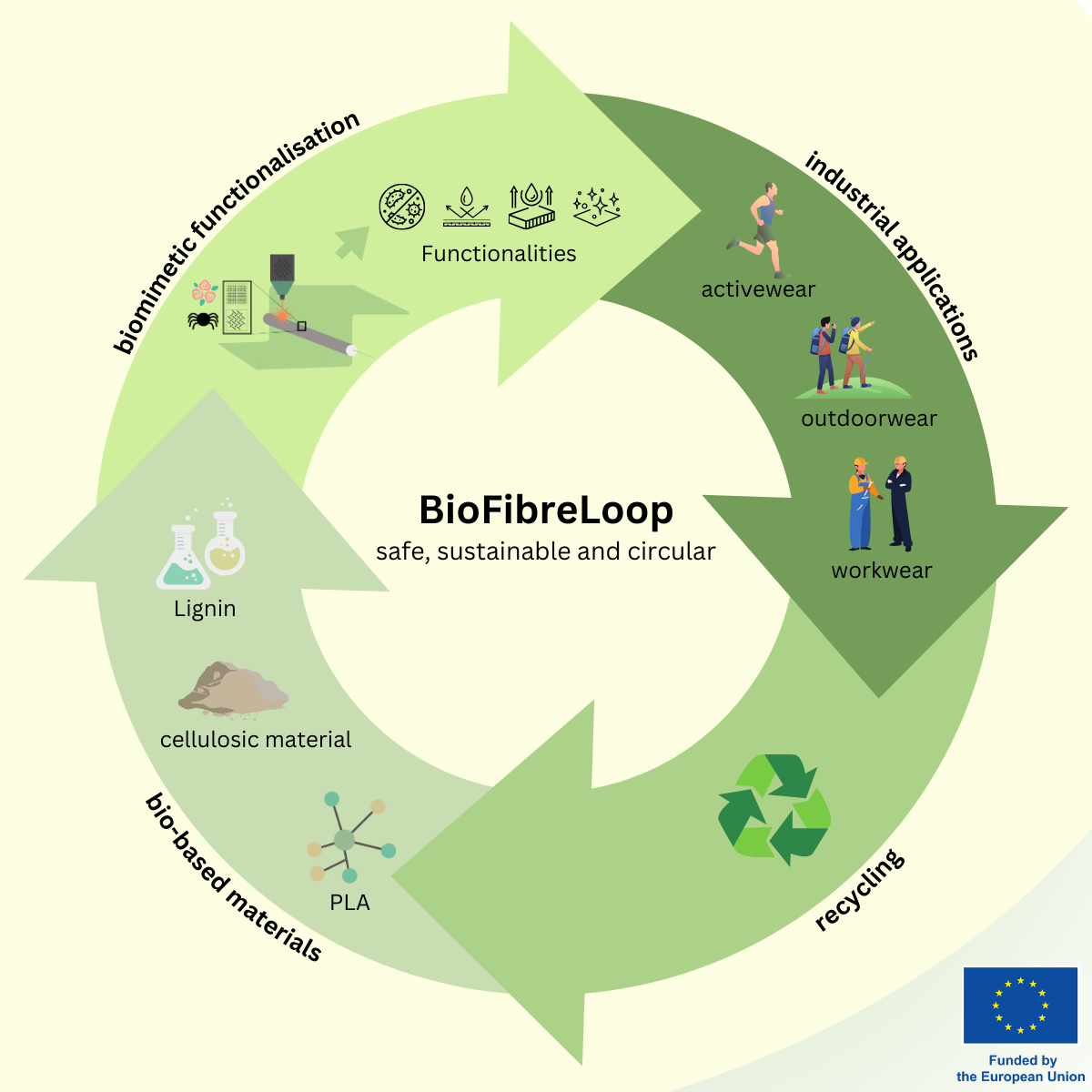
It is to address this challenge that ALPhANOV is launching the SAFEST project, following BioFibreLoop. That earlier project focused on developing bio-based, circular technical textiles. It explored new bio-based materials and how laser technologies could give textiles innovative functionalities.
SAFEST extends this approach but shifts the focus from the material to its surface. Making textiles more sustainable is not enough: they also need to be protected and functionalized to meet the demands of industrial applications.
The project therefore aims to develop a new generation of PFAS-free, bio-based, high-performance surface treatments.
Complementary technologies for industrial applications
To create durably hydrophobic and oleophobic surfaces, SAFEST combines three approaches:
- Bio-based coatings. The project relies on two materials: thermoplastic lignin, derived from biomass, and functionalized nanocellulose, whose properties show great promise for surface functionalization. These coatings will make textiles water- and oil-repellent.
- Laser surface structuring. Femtosecond lasers can texture rollers with high precision. These rollers are then used to emboss textiles continuously in a roll-to-roll process compatible with industrial production rates.
- Molecular grafting. This technique functionalizes surfaces at the molecular level, so the desired properties last over time.
The solutions developed will then be tested and validated against several criteria: water and oil repellency, UV and chemical resistance, stiffness, odor and ease of cleaning. One of the project's major challenge will be to show that these treatments can be integrated into existing textile production lines and deployed on an industrial scale.
SAFEST will showcase its solutions in four technical textile applications: workwear, protective clothing for firefighters, upholstery and interior textiles, and automotive textiles.
The goal is to reach Technology Readiness Level 7 (TRL 7) by the end of the project, meaning the solutions will be validated under conditions representative of their industrial use. Beyond technological development, SAFEST will assess the safety and sustainability of its solutions using the Safe and Sustainable by Design (SSbD) approach. The aim is to make it easier for manufacturers to adopt them and to ensure they comply with future regulations.
The partners
Financial supporters
Horizon Europe - key funding program for research and innovation (contract number: 101293286)

Beginning of the project: 2026, November 1st