
CNES R&T Project Photonic Lanterns
As part of a collaborative R&T project with CNES , ALPhANOV aims to photo-inscribe with a femtosecond laser a photonic lantern operating at 1550 nm. This work addresses a critical need for free-space optical communications and contributes to the development of compact, polarization-maintaining solutions compatible with photonic integrated circuit (PIC) interfaces.

Which technologies for space-compatible photonic lanterns?
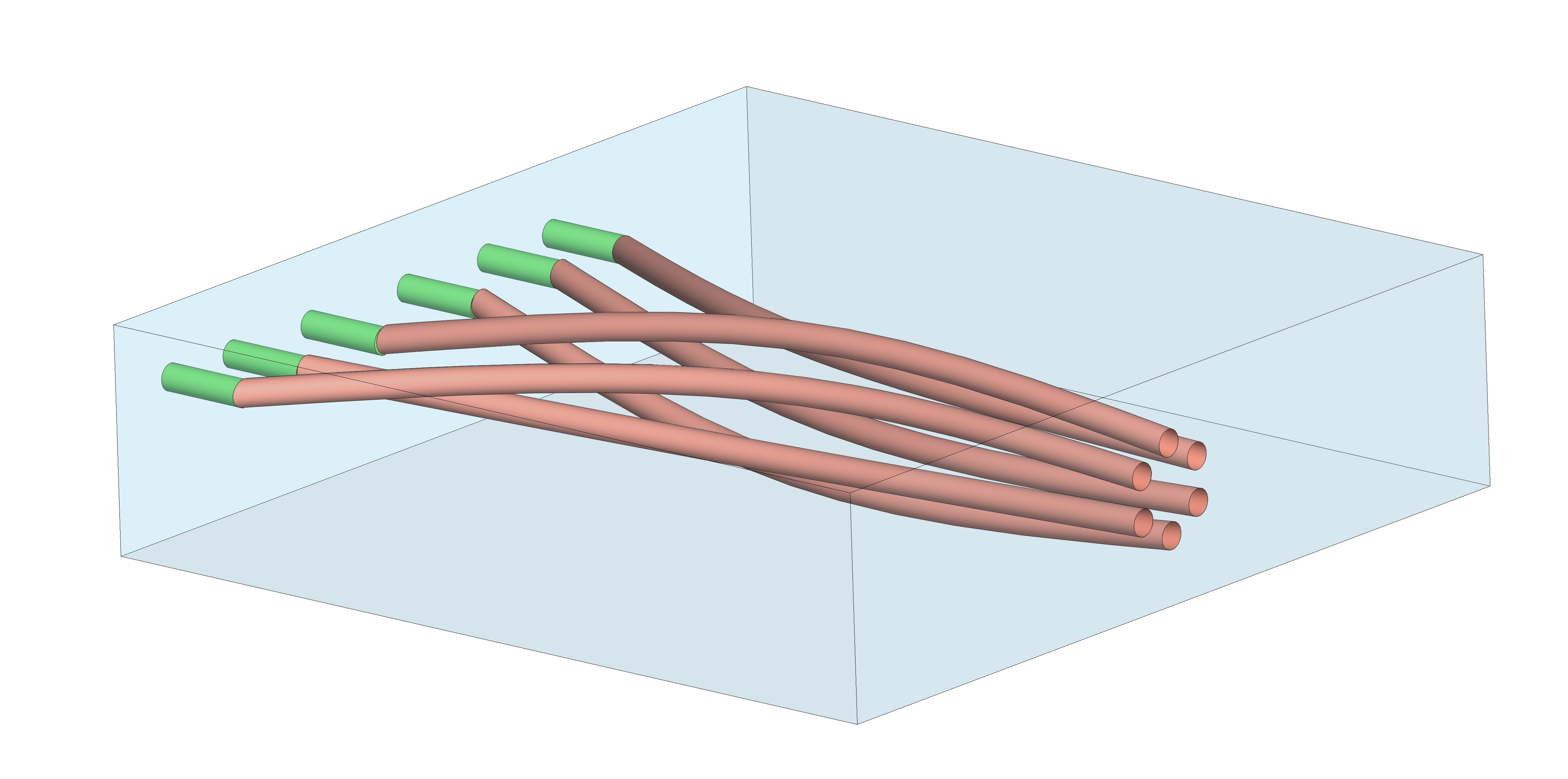
Photonic lanterns are components designed to mitigate the effects of atmospheric turbulence encountered during optical signal propagation, for example in satellite-to-ground communications. They are used in conjunction with a PIC, which performs coherent combination of the signals collected in each single-mode channel in order to recover a high-data-rate signal.
Today, most photonic lanterns are fiber-based, which limits their integration into embedded systems and adds complexity when interfacing fiber outputs with PICs. Their fabrication process, based on fiber fusion and tapering, also restricts the number of usable ports and does not easily support polarization-controlled beams.
In this context, the goal of this R&T is to propose a compact, polarization-maintaining, photo-inscribed solution that enables straightforward interfacing with PICs, made possible through femtosecond-laser inscription. This approach paves the way for components that are better suited to space constraints and more easily industrialized.
The role of ALPhANOV and its partners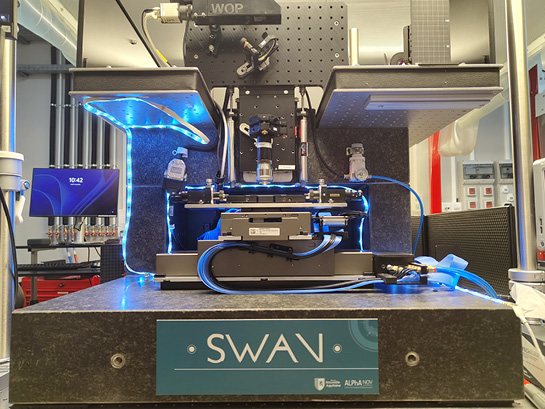
ALPhANOV, specifically its "Laser Sources and Components Department", will be responsible for the design of the photonic lanterns, their laser inscription, and their characterization, to ensure adequate coupling efficiency and low insertion losses.
The center already has the necessary facilities, characterization platforms, and expertise in the fabrication of waveguides and couplers required for the successful execution of the project. The architecture of a photonic lantern requires three-dimensional inscription within the bulk material: as such, this project also represents an opportunity to further develop expertise in laser inscription, particularly through the development of depth-control methods.
Thales R&T, in collaboration with TAS-France, will contribute to the project by performing characterization of the produced lanterns. Their expertise will enable the evaluation of device performance in representative satellite-to-ground communication scenarios, thereby validating the relevance of this technology in operational environments.
This project falls within the space sector, where photonic technologies are emerging as a key solution to meet environmental constraints and to enable the development of next-generation optical communications.
Project duration: 15 months