News
LUMEN Project: Toward visible fiber lasers
Launched in april 2025, the LUMEN project aims to establish international leadership in the development of high-power continuous-wave fiber lasers emitting directly in the visible spectrum (500-700 nm), a spectral range that remains largely underserved despite strong industrial demand, particularly in biophotonics and quantum technologies.

Developing new laser solutions in the visible spectrum
In this wavelength range, particularly at power levels above 1-2 W, industrial laser solutions remain limited. The LUMEN project aims to overcome these technological barriers by developing laser sources based in particular on rare-earth-ion-doped fluoride fibers.
Beyond the targeted performance, the project addresses a strategic challenge for the French photonics industry: establishing a fully domestic value chain, from fluoride fiber manufacturing to the integration of the final laser source.
A first year marked by significant progress
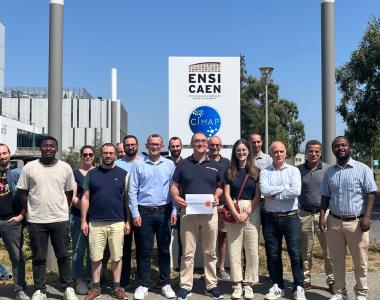
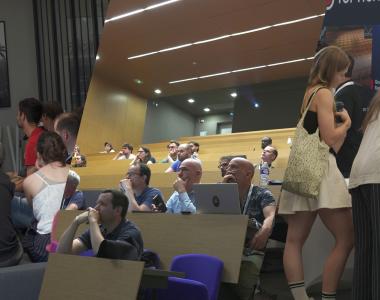
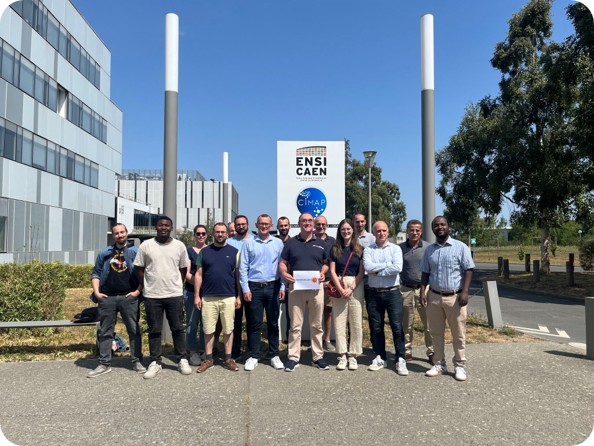
A key milestone marking the end of the project's first year took place in July at the CIMAP laboratory in Caen, bringing together all of the consortium's industrial and academic partners (Oxxius, Le Verre Fluoré, CORIA Laboratory, and Hubert Curien Laboratory).
The meeting provided an opportunity to share the project's first technological advances. Amplification results obtained using a new ZBLAN fiber developed by Le Verre Fluoré (LVF) were presented, along with extensive work aimed at understanding the physical phenomena responsible for noise generation across the various laser architectures under consideration.
The partners also presented their progress in developing hybrid silica/ZBLAN components, particularly in fiber splicing processes and the development of pump and signal combiners.
Promising results for fiber bragg gratings
As part of the LUMEN project, ALPhANOV is working on the development of reflective fiber Bragg gratings (FBGs) for the visible spectrum, using femtosecond laser inscription in different types of fibers, including both silica and fluoride glass fibers.
This first project milestone meeting provided an opportunity to present particularly encouraging results: the fabrication of a highly reflective FBG in a single-mode silica fiber at 635 nm, achieving a net reflectivity of 94%.
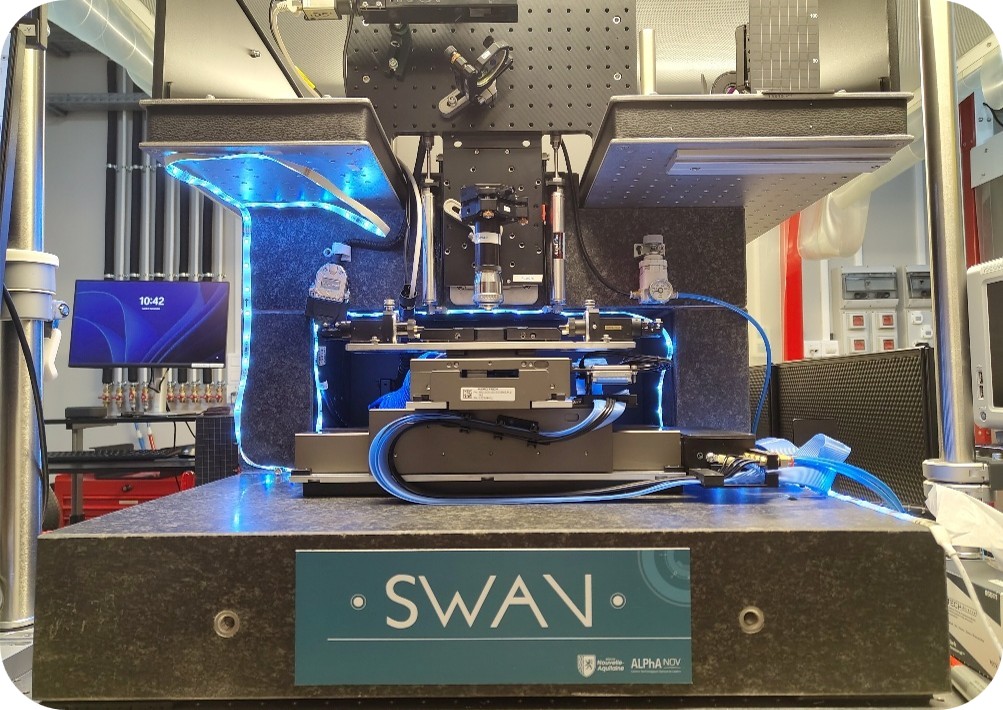
This performance was made possible in particular by the use of new high-resolution translation stages, acquired as part of the LUMEN project. Several gratings have already been delivered to consortium partners for further testing in future laser architectures.
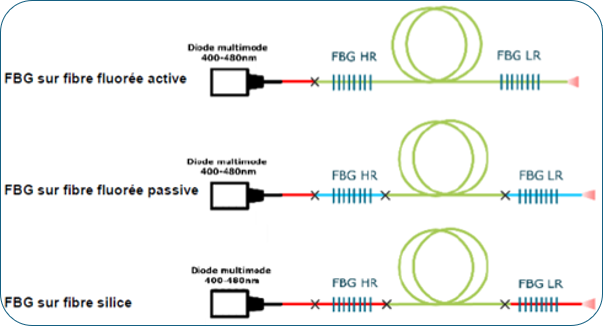
These initial results demonstrate the feasibility of femtosecond laser inscription in this visible wavelength range and pave the way for the development of a monolithic fiber laser cavity architecture.
 |
 |
Inscription platform with the new translation stages |
Monolithic fiber laser architecture Green: Pr-doped ZBLAN fiber Blue: Undoped ZBLAN fiber Red: Silica fiber |
The next steps will focus in particular on the fabrication of low-reflectivity FBGs and inscription testing in LVF's ZBLAN fibers.
Funding: i-démo

This project was funded by the French government as part of the France 2030 program.