Thermal Laser Stimulation - TLS
The Thermal Laser Stimulation option enables the detection and evaluation of IC vulnerabilities for hardware security. It can be used to enhance overall hardware security and accelerate secure product development. TLS reveals and maps logical states of transistors in the IC area of interest through backside laser scanning. The laser beam is used to induce a localized thermal gradient on the illuminated transistors, which in turn is creating an electrical voltage, inducing currents (Seebeck effect) according to the logical state of the transistor.
Principle
The TLS option consists of scanning an IC’s region of interest through its backside using a laser beam. The laser beam is used to induce a localized thermal gradient on the illuminated transistors, which in turn creates an electrical voltage, inducing currents (Seebeck effect) according to the logical state of the transistor.
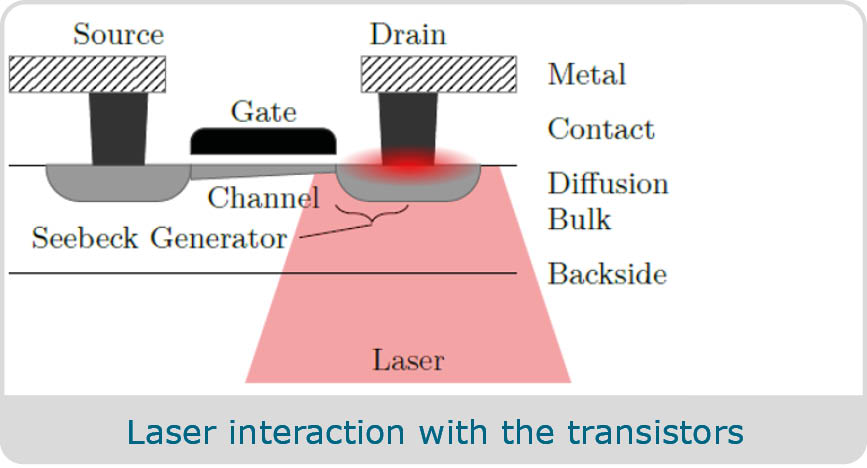
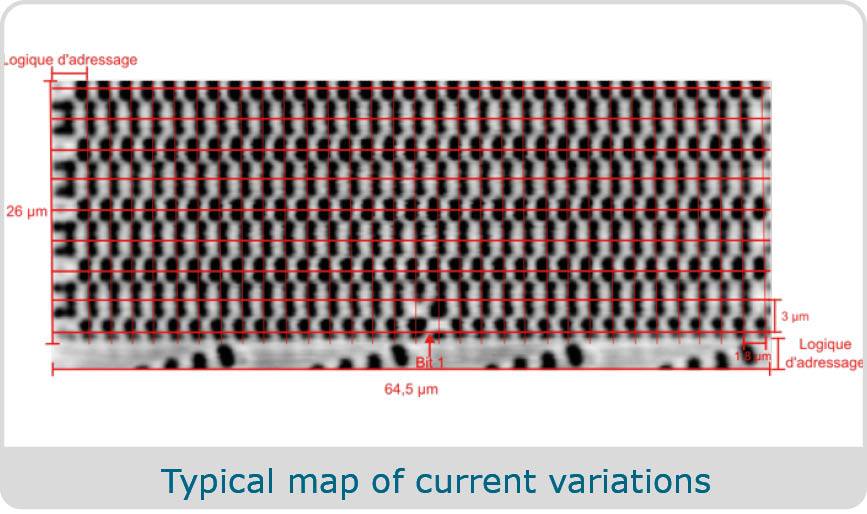
For each position sampled in this way, the current consumption is measured and translated into a grayscale.
At the end of the acquisition, we obtain a map highlighting the areas of the circuit that showed a difference in power consumption under the influence of the laser beam, which allows us to deduce the data stored in each memory cell.
Protocol
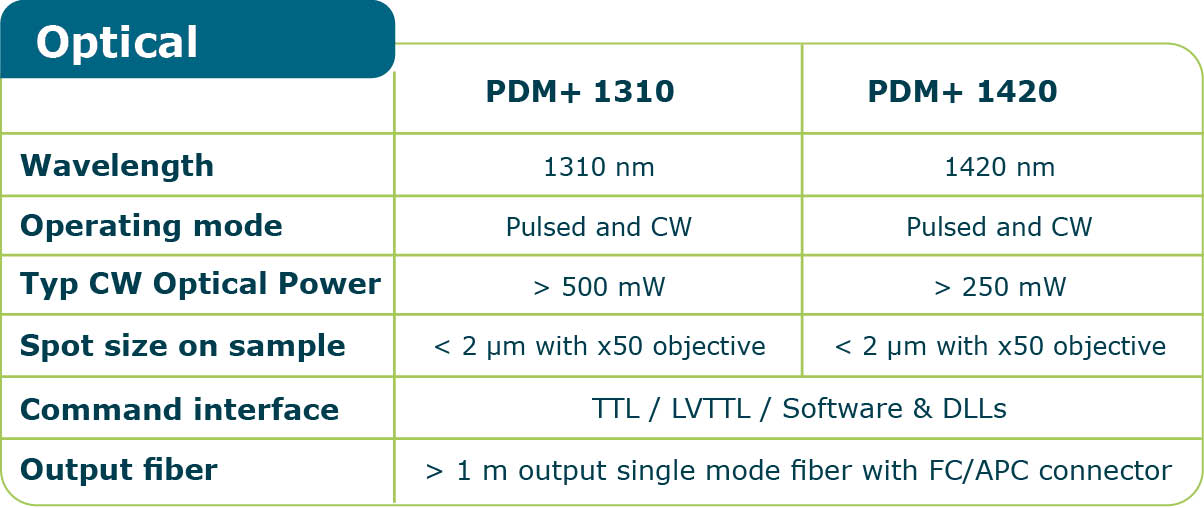
The laser is used in continuous mode, and the beam is directed to the sample through the x50 objective of the microscope column. This objective is used to get the smallest spot size on sample and therefore the finest mapping resolution. A displacement of the laser beam on a sample selected area is programmed. The acquisition card, connected to the PC via PCI, will buffer the values of the signal at a pre-programmed frequency. The scanning speed and the data sampling rate define the spacing between 2 consecutive data points.
After the acquisition, the grayscale map representing the scanned transistors’ state is rebuilt by software running on the acquisition PC.
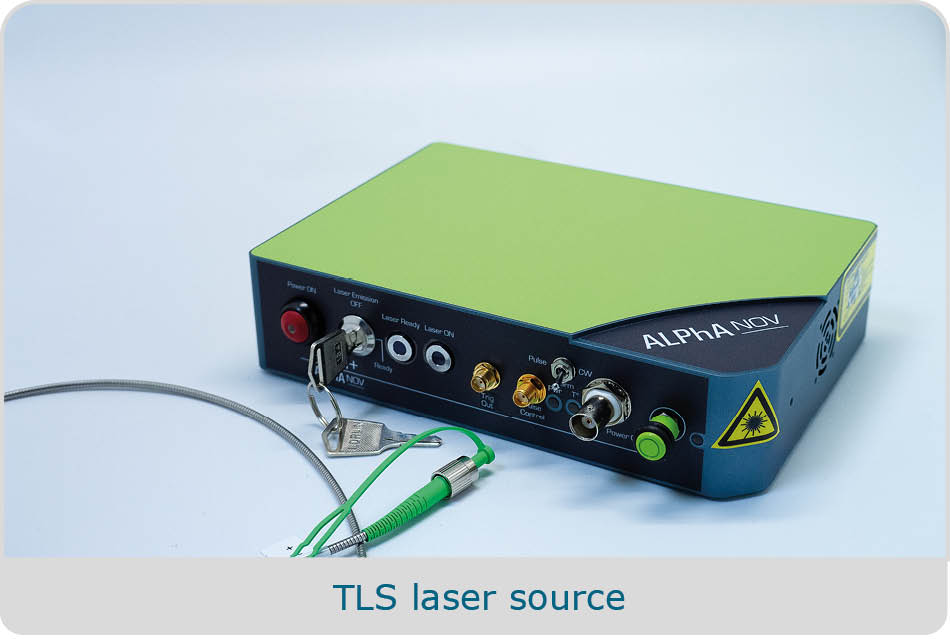
TLS kits includes:
- 1310 nm or 1420 nm laser
- A laser injection port
- A transimpedance current amplifier
- A multiple BNC input board
- PCIe acquisition card
Datasheet
 |
The LMS station are fully compatible with esDynamic Analyst Development platform from eShardesDynamic software platform allows security experts to analyze, attack, pinpoint and refine the security of their products by performing side-channel, white-box cryptography analysis or fault injection. With esDynamic platform, eShard offers dedicated contents in its Hardware Analysis module to drive ALPhANOV equipment and perform precision fault injections attacks. |

|
|
|