
With this < 50 picosecond laser, the charges creation time is reduced compared to the classic PDM lasers, enabling new possibilities for the fastest Integrated Circuits.
Why use a picosecond laser source to test integrated circuits?
The latest generations of microcontrollers, SoCs (system on chip) or FPGAs are operating at ever higher frequencies and integrate ever finer technologies.
In the security evaluation or failure analysis fields, laser fault injection therefore will benefit from lasers with shorter and shorter pulse durations. Using a source in the picosecond domain opens a new field of exploration.
It makes it possible to inject disruptions over short cycle times and to obtain better spatial resolution in order to gather desired effects in the component.
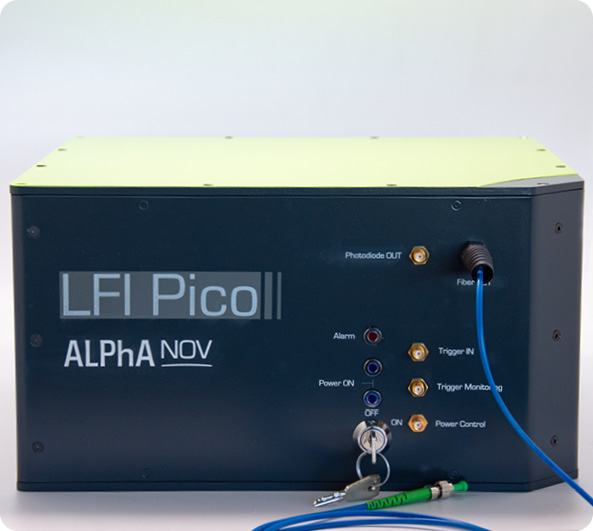
Why is the LFI Pico laser source particularly suitable for this application?
The LFI Pico is an innovative laser source generating < 50 ps optical pulses, developed specifically for laser fault injection in integrated circuits, whether for security testing or failure analysis.
The particularity of this LFI Pico source is its ability to generate pulses on demand from a single shot up to 10 MHz, from an external trigger, and most importantly with very low jitter (<100 ps Std Dev).
This feature enables the users to precisely control the timing of the pulse injection into the sample, synchronizing the laser starting from the electronic component under test, and not the other way around. Its fully fibered architecture makes it a particularly reliable and compact laser source.
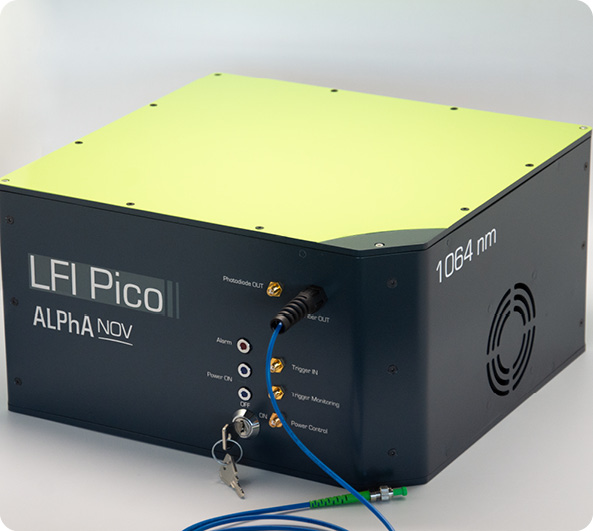
Do I need a different test bench to use the LFI Pico?
The LFI Pico source is directly compatible with all ALPhANOV laser test benches developed for laser fault injection such as the S-LMS and the D-LMS without any modification.
The fiber connector of the LFI Pico is identical to the PDM one and the user can just connect the LFI Pico instead of its PDM with no other alignment needed.
Technical specifications
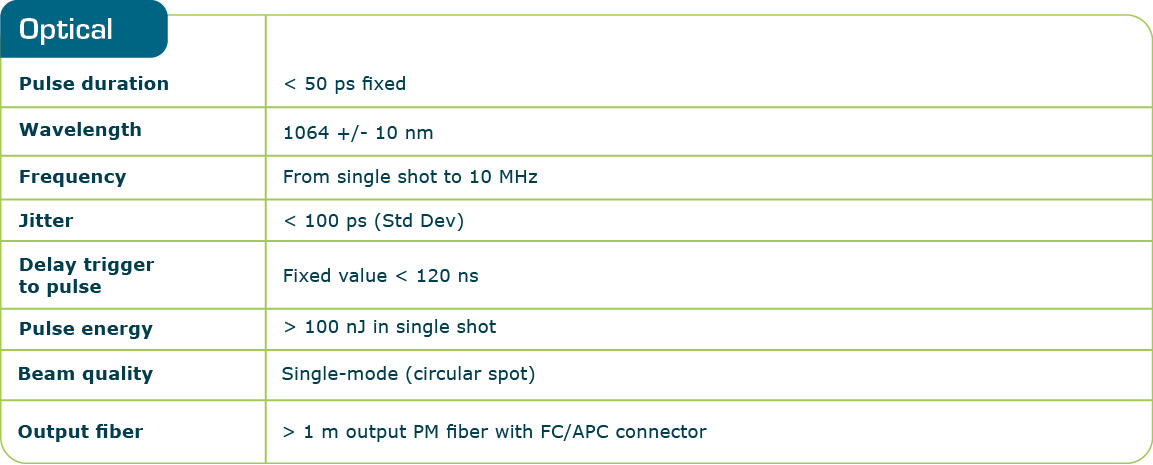
Datasheet
Applications
- Integrated circuits evaluation and testing
- Integrated circuits failure analysis
- Laser fault injection
- Single events effects testing / screening


